Siri AI Is Finally Here — But Is Apple Too Late?
Siri Finally Feels Like the Assistant Apple Promised
Siri AI has finally arrived, and for years, it has felt like the one part of the iPhone experience that Apple simply hadn’t managed to move forward enough.
It could set alarms, send messages, make calls, and answer simple questions. But ask it something slightly more complicated, and there was a good chance you’d end up rephrasing the same request—or reaching for Google.
That started to feel increasingly strange as AI assistants became dramatically more capable.
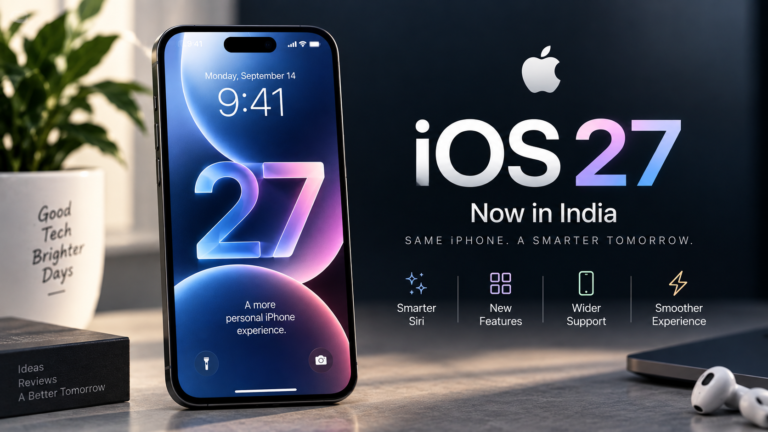
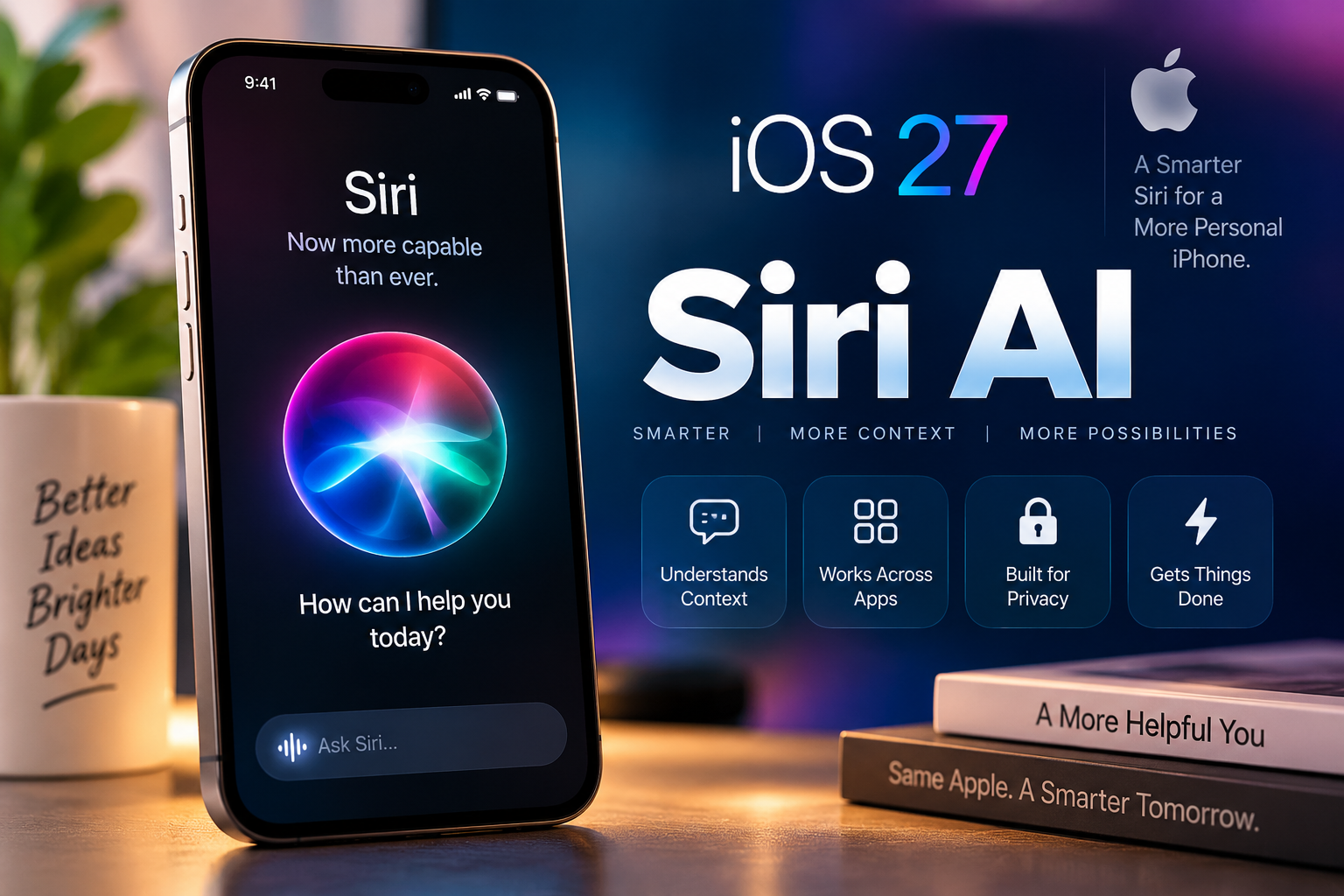
Now, with iOS 27, Apple is finally giving Siri the kind of intelligence we’ve been expecting from it for years. The new Siri can understand more natural requests, use context from your conversations and information on your device, and perform actions across apps. Apple is also bringing visual intelligence into the Siri experience.
And honestly, this is the Siri I wanted Apple to build years ago.
The interesting part isn’t simply that Siri can now answer more questions. It’s that Apple is trying to turn Siri from a voice command tool into something that can actually understand what you’re trying to do.
That sounds like a small change.
It isn’t.
The New Siri Understands More Than Just Your Words
The biggest change isn’t that Siri suddenly knows more facts. It’s that Apple is trying to make Siri understand context.
Instead of treating every request as a completely separate command, the new Siri can use information from what you’ve already said and, in some cases, information available on your device.
That makes conversations feel much more natural.
For example, you could ask Siri about something in a message or email and then follow up with another request without having to repeat every detail. Apple calls this personal context, and it’s one of the foundations of the more capable Siri experience.
This is the direction I think Siri needed to take.
A useful assistant shouldn’t make you think about the exact words you need to say. You should be able to talk to it almost like you would talk to another person.
And Apple is finally moving Siri in that direction.
But there’s another upgrade that could be even more useful in everyday life—Siri can now understand what you’re actually looking at on your iPhone.
Your iPhone Screen Is Now Part of the Conversation
This is where Siri starts feeling much more useful.
With Visual Intelligence, Siri can understand information on your screen and help you act on it. So instead of explaining everything you’re looking at, you can let your iPhone provide the visual context.
Imagine you’re looking at a product, an event, a location, or some information on your screen and want to know more about it. Rather than copying text, switching between apps and searching manually, Siri can use what’s on your screen as part of the request.
Apple is also connecting this capability with its broader Apple Intelligence experience, including visual understanding and actions based on what the iPhone sees.
And this is exactly the kind of feature that makes AI feel useful rather than gimmicky.
The best AI features aren’t necessarily the ones that look impressive in a demo. They’re the ones that remove a few annoying steps from something you do every day.
But understanding what’s on your screen is only half the story.
The more important question is: can Siri actually do something about it?
Siri Can Finally Do Things Instead of Just Answering
This is the part that could make the biggest difference in everyday use.
For a long time, Siri was mostly reactive. You asked a question, it gave you an answer. You gave it a command, and it tried to carry it out.
The new Siri is designed to go a step further by taking actions across apps. Apple has shared more details about these capabilities on its official iOS 27 page.
That means a request doesn’t necessarily have to end with Siri telling you what to do. Apple is working toward Siri being able to understand your intent and interact with apps to complete tasks for you.
That could eventually mean less jumping between apps, copying information manually, and repeating instructions.
And this is where I think Apple’s approach has real potential.
The most useful AI assistant isn’t the one that talks the most. It’s the one that saves you the most taps.
There is, however, a fairly big catch to all of this—and it could determine how many people actually get to experience the new Siri.
But There’s a Problem: Not Every iPhone Gets the Smart Siri
This is where the excitement around Siri AI needs a little reality check.
The new, more capable Siri isn’t simply arriving on every iPhone that can run iOS 27. Apple Intelligence features require compatible hardware, and Apple says the newer Siri experience is available on supported iPhone models, including iPhone 15 Pro and 15 Pro Max, and iPhone 16 models or later. Availability can also vary by language and region.
That means someone with an older supported iPhone may be able to install iOS 27 but still miss out on some of the features that make the new Siri interesting.
I think this distinction is important because saying “iOS 27 brings AI-powered Siri to iPhones” can make it sound as though everyone gets the same experience.
They don’t.
And there’s another limitation worth remembering: Apple is still rolling out some of these capabilities, so the Siri experience you see today may not be the final version Apple has in mind.
Which brings me to the bigger question: after waiting this long, has Apple actually caught up with the competition?
Apple Is Still Playing Catch-Up in the AI Race
This is the part where I find Siri AI a little complicated.
What Apple is showing with the new Siri is genuinely impressive. The problem is that the competition has already been doing many of these things for a while.
ChatGPT and Gemini have changed what people expect from an AI assistant. We’re no longer impressed simply because an assistant can understand a natural-language question. We expect it to understand context, work with information, handle follow-up questions, and help us get things done.
So when Apple finally brings these capabilities to Siri, my reaction isn’t “Wow, Apple has completely changed the game.”
It’s more like:
“Finally. This is what Siri should have been.”
That doesn’t make Apple’s work unimportant. In fact, integrating AI deeply into iOS could eventually make Siri more useful than a standalone chatbot for certain everyday tasks.
Apple also has something the competition doesn’t quite have in the same way: control over the hardware, operating system, and apps.
If Apple gets that integration right, Siri could become genuinely powerful.
But Apple now has to prove that it can turn all of that potential into an assistant people actually want to use.
And there is one area where Apple may have a very strong advantage: privacy.
Privacy Could Be Siri’s Biggest Advantage
There’s one area where I think Apple has a more convincing story than simply saying, “Our AI is smarter.”
Privacy.
Apple has built Apple Intelligence around on-device processing where possible, while more complex requests can use its Private Cloud Compute infrastructure. The idea is that your personal information should be used to make Siri more useful without becoming something that Apple simply collects and stores for advertising or profiling.
And for an assistant that could potentially access things like your messages, emails, photos, and personal context, that matters.
I would personally be much more comfortable giving an AI assistant access to sensitive information if I knew the system was designed around privacy rather than treating my data as another resource to monetize.
Of course, privacy alone won’t make Siri a great AI assistant.
It still needs to be fast, accurate, and genuinely useful. If Siri misunderstands requests or can’t complete basic tasks reliably, users won’t care how impressive Apple’s privacy architecture is.
That’s why I think Apple has the right foundation—but now it needs to execute.
So after all this waiting, is Siri AI actually worth the hype?
So, Is Siri AI Actually Worth the Hype?
I think it is—but with an important “wait and see” attached.
The new Siri is finally moving in the direction Apple should have taken years ago. Understanding context, seeing what’s on your screen, and eventually performing actions across apps could make it far more useful than the Siri we’ve had for years.
But I wouldn’t call it an AI revolution just yet.
A lot of what Apple is introducing has already become familiar through ChatGPT and Gemini. And because some of Siri’s more ambitious capabilities are still being rolled out, we haven’t yet seen the complete experience Apple is promising.
For me, that’s the biggest issue with Siri AI right now.
The potential is obvious. The execution still needs to prove itself.
If Apple can make Siri consistently understand what I mean, access the right information, take the right action, and do all of that while respecting my privacy, then Siri could finally become something I actually use every day.
Until then, I’m impressed—but I’m not ready to declare Siri the winner of the AI assistant race.
After years of waiting, Siri is finally catching up. Now Apple needs to show us that it can stay ahead.
My Take: Siri Finally Has a Future
After using Siri for years, I think iOS 27 marks an important change—not because Siri has suddenly become the smartest AI assistant around, but because Apple is finally treating Siri like an AI assistant rather than a voice-command feature.
The direction is right.
The bigger question is how quickly Apple can turn these promises into a polished, dependable experience for everyone.
For now, I’d call the new Siri promising rather than revolutionary.
And honestly, that’s okay.
Apple doesn’t necessarily need Siri to beat ChatGPT or Gemini at everything. It needs Siri to become the assistant that works naturally with your iPhone, your apps, and your everyday life.
If Apple can nail that, Siri may finally become one of the most useful parts of owning an iPhone.
Better late than never—but Apple has a lot to prove.
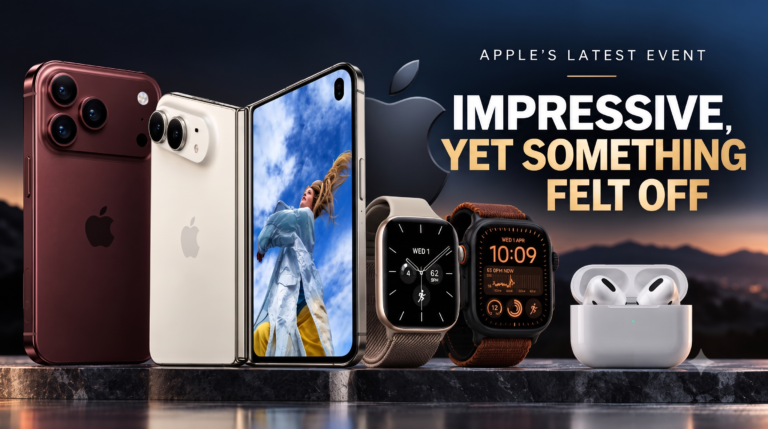
I’ve also shared my thoughts on Apple’s latest event and why, despite the impressive hardware, the event left me with mixed feelings.