YouTube Premium After 5 Years: Is It Still Worth Paying For in 2026?
Introduction
Five years is a long time for any subscription service. And yet, I’m still paying for YouTube Premium.
I started using YouTube Premium in November 2021, when I was paying just ₹139/month (about $1.45 at today’s exchange rate). At the time, my reason was simple: I was tired of YouTube ads.
Five years later, that ₹139 subscription has turned into a ₹299/month Family plan (about $3.13 today). The price has gone up, my usage has changed, and YouTube has added a few things along the way. Yet, I’ve never really felt the need to leave it.
That, however, doesn’t mean I use every Premium feature equally—or that I think everything about the service is perfect.
So what exactly has kept me subscribed for five years? And after going from ₹139 to ₹299 a month, is YouTube Premium still worth paying for in 2026?
I’ve been using it across my phones, laptop and PC since 2021. This is what five years of actual use has taught me.
Why I Started Using YouTube Premium
Back in November 2021, I was using YouTube mostly on my iPhone and PC, just like I do today. But there was one thing that increasingly started getting on my nerves: YouTube ads.
The ads before the videos were particularly frustrating. Sometimes, I would get two or even three ads before a video had properly started. And if the video was longer than eight minutes, interruptions could appear in the middle as well. For me, this gradually started affecting the entire viewing experience.
I had been using YouTube for years without paying anything, so I never really used any workaround to get rid of the ads. I simply lived with them.
Then I came across YouTube Premium, which offered exactly what I wanted: an ad-free YouTube experience. But there was a catch—I had to actually pay for it.
At that time, ₹139 a month (about $1.45 at today’s exchange rate) didn’t sound particularly cheap to me. It felt strange to start paying for a service I had been using for free for years, especially when the primary reason was simply to remove ads. Still, the frustration had reached a point where I decided to give it a try.
And once I started using Premium, the absence of ads was immediately noticeable. But surprisingly, it wasn’t the only thing I appreciated. Background Play turned out to be a genuinely convenient addition, while being able to download videos in Full HD made offline viewing much more useful for me.
What started as a simple attempt to escape YouTube ads eventually became a subscription I would continue using for years.
Living Without YouTube Ads for 5 Years
When I first subscribed to YouTube Premium, the immediate difference was obvious: the ads were simply gone. No more waiting for an ad to finish before a video starts. No more interruptions breaking the flow of a video midway. The overall experience felt noticeably smoother, and the frustration I had associated with YouTube ads almost disappeared overnight.
But what surprised me more was how quickly I got used to it.
After five years, watching YouTube without ads has become such a normal part of my experience that I can hardly imagine going back. I rarely use YouTube on a device that doesn’t already have Premium, but whenever I do come across the normal ad-supported experience, it immediately reminds me how different the two experiences can feel.
I wouldn’t say I consciously think about ads every time I open YouTube. It’s almost the opposite now—the absence of ads has become something I simply expect. And if I had to go back to watching YouTube with frequent interruptions, I honestly don’t think I’d enjoy it nearly as much as I do today.
For me, that makes ad-free playback the single most important feature of YouTube Premium. After five years, it’s no longer just the reason I subscribed; it’s the main reason I continue to stay subscribed.
Background Play: The Feature I Use the Most
One of the first Premium features I started using almost immediately was Background Play, and five years later, it remains one of the most convenient parts of the subscription for me.
I use it most often when I’m going to sleep. I’ll start a Hindi case-study video or a podcast, turn the screen off, and simply continue listening without having to keep my phone’s display on. I also use it occasionally while going for a walk.
For videos from creators like Dhruv Rathee and Nitish Rajput, I often treat the video almost like an audio program—although if the topic is particularly interesting, I’ll turn the screen back on to watch the visuals as well.
What I particularly appreciate is how reliable Background Play has been. Over nearly five years of using it, I haven’t experienced any major issue where playback suddenly stopped, the app crashed, or the feature became unreliable in a particular situation. It has simply worked in the background when I’ve needed it.
Would I still keep YouTube Premium without Background Play? Honestly, I’m not completely sure. I might reconsider the subscription if this feature disappeared. But ad-free playback is still the foundation of my Premium experience, so Background Play isn’t the only reason I’d stay—it is one of the features that makes the subscription considerably more useful to me.
Offline Downloads After 5 Years
I don’t download YouTube videos all the time. Most of the time, I only use this feature when I know I’ll need it—especially when I’m travelling or when I expect to be in an area with poor network coverage.
During travel, offline downloads have been genuinely useful on several occasions. If I happen to enter a low-signal area, I can simply watch something I’ve already downloaded instead of worrying about whether YouTube will buffer. It’s not something that completely changes my travel experience, but it has definitely made it more convenient.
I usually download videos in Full HD, although I wouldn’t necessarily call it my preferred quality today. I haven’t been offered anything higher than Full HD for offline downloads, so that’s what I use, and it gets the job done.
Over nearly five years, downloads have been mostly reliable. There have been occasional instances where a download failed or offline playback didn’t work as expected, but these problems have been rare and minor enough that they haven’t really affected my overall experience.
Interestingly, though, offline downloads aren’t a feature that determines whether I would keep paying for Premium. If YouTube removed offline downloads tomorrow, I’d certainly miss the convenience, but it wouldn’t be enough to make me cancel my subscription. For me, ad-free playback and Background Play remain much more important.
That said, there is one improvement I’d genuinely like to see from YouTube. It should offer download quality options above Full HD, especially 4K. We are well into the 4K era now, and while Full HD is perfectly adequate for many situations, Premium subscribers should have the option to download higher-resolution videos when the original content supports it. At the very least, having a 4K download option would make the offline viewing experience feel more future-ready.
YouTube’s 1080p Premium Quality
One feature I didn’t pay much attention to when I first subscribed to YouTube Premium was the 1080p Premium quality option. I only noticed it much later, when I started comparing it with the regular Full HD option.
The difference isn’t dramatic, and I wouldn’t say it suddenly transforms the viewing experience. However, when I compare the two, I can notice a minor improvement in overall video quality with Full HD Premium. It’s subtle, but it is there—at least in the videos where the difference is easier to notice.
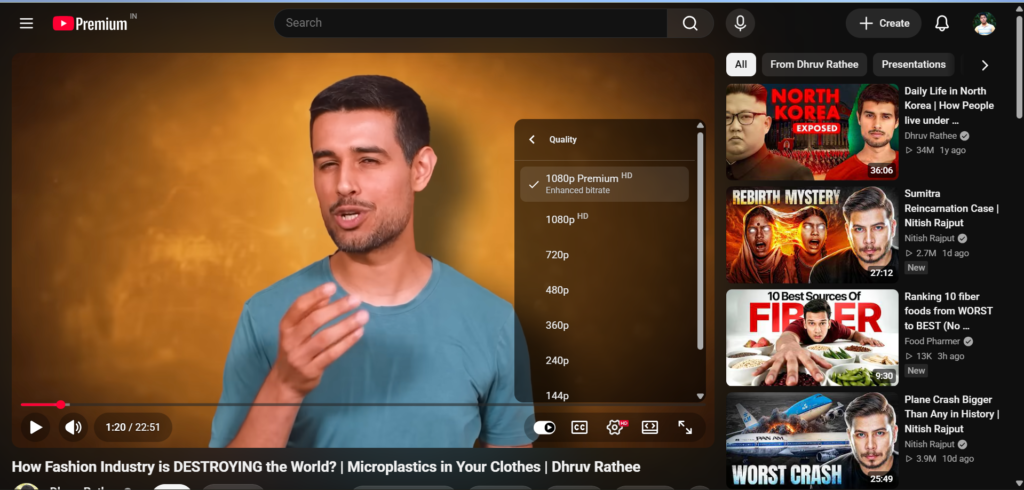
For me, it’s not a feature that alone justifies paying for YouTube Premium. The ad-free experience remains far more important. But since this higher-quality option is available to Premium subscribers, I do appreciate having the choice when I want to get a little more out of the video quality.
And this is one of those features that I think works better when you actually compare it yourself rather than simply reading about it.
YouTube Music: Useful, But Not the Best
I regularly use YouTube Music, mostly on my phone. Most of what I listen to is Hindi and English music.
Over time, I’ve also discovered quite a few new songs and artists through its recommendations. In fact, this is one area where I think YouTube Music does a genuinely good job—the recommendations often feel surprisingly accurate and can introduce me to music I might not have searched for myself.
Its music library is also quite extensive, and I like the simple, no-nonsense approach of its interface. It doesn’t feel complicated, and finding something to listen to is generally straightforward.
But when it comes to audio quality, I don’t think YouTube Music is quite on the same level as Spotify or Apple Music. Every now and then, I can notice a slight difference in detail and bass, particularly when switching between services.
It’s not something that makes YouTube Music sound bad—it is perfectly fine for everyday listening—but the difference becomes noticeable when I compare it directly with the alternatives.
The interface is another area where I think YouTube Music could do better. It’s clean and functional, but Spotify and Apple Music feel more polished and visually engaging to me. YouTube Music’s interface doesn’t have quite the same futuristic or eye-catching feel.
That said, there’s one reason I continue to use it regularly: it’s already included with my YouTube Premium subscription. If I had to pay separately for YouTube Music, I honestly wouldn’t subscribe to it. For me, its inclusion in Premium makes it a useful bonus rather than the primary reason to pay for the subscription.
Using YouTube Premium Across Devices
One thing I particularly appreciate about YouTube Premium is how consistent the experience has been across my devices.
I use the same Google account on my iPhone, Pixel, another Android device, laptop, and PC, and Premium has worked reliably across all of them.
I’ve never had an issue where YouTube failed to recognize my Premium subscription on a particular device or asked me to repeatedly verify my membership. Once I’m signed in, the Premium experience simply follows me from one device to another.
The core features I’ve used over the years—especially ad-free playback, Background Play, and offline downloads—have also remained consistent across these devices. I haven’t noticed any meaningful difference in how Premium behaves on my iPhone compared with my Android devices or computers.
For something I use across so many devices, that consistency matters. I don’t have to think about whether a particular device will support my Premium benefits; I can simply sign in and use YouTube normally.
My rating for the overall multi-device experience: 9/10.
What I Don’t Like About YouTube Premium
After using YouTube Premium for nearly five years, I don’t have many major complaints about the service itself. Most of the features I use work reliably, and even after the price increases, I still consider the subscription reasonably priced for what I get.
However, there is one area where I think YouTube could make Premium considerably more attractive: exclusive content.
I’d love to see YouTube offer Premium subscribers a stronger library of YouTube Originals and exclusive documentaries at no additional cost. Unlike simply removing ads or adding another convenience feature, exclusive content would give people another reason to keep their Premium subscription.
For example, if YouTube started investing in a few major original productions comparable in ambition to the kind of shows people associate with services like Netflix or Prime Video, the value proposition could become much stronger.
Even a small but high-quality catalogue of genuinely exclusive movies, documentaries, and series could make Premium feel like more than just an upgraded version of regular YouTube.
I don’t think this is something YouTube needs to do to make Premium worthwhile for me today. But if it did, I’d feel that my subscription offered considerably more value for the money.
If I could suggest just one improvement to YouTube, it would be simple: invest in bigger, high-quality YouTube Originals and exclusive documentaries that are available to Premium subscribers without an additional charge.
YouTube Premium Pricing: From ₹139 to ₹299
When I first subscribed to YouTube Premium in November 2021, I was paying just ₹139 per month (about $1.45 at today’s exchange rate). At that time, I was using an individual plan, and while ₹139 initially felt a little expensive to me, I eventually became comfortable with it because the ad-free experience made such a noticeable difference.
By 2023, I had moved to the Family plan, which cost me ₹189 per month (about $1.98). That price already made more sense to me because the subscription could be shared with other members of my family.
Then came another significant price increase. YouTube raised the price of the Family plan from ₹189 to ₹299 per month (about $3.13), and I remember my initial reaction being quite negative. I wasn’t happy about paying considerably more for something I had already been using for years.
But the way I look at that ₹299 today is very different from how I would look at it if I were paying it for myself alone. Four other people besides me use the Family plan, which makes the cost considerably easier to justify. In that sense, ₹299 still feels like a good deal to me.
Would I personally pay ₹299 every month for an individual YouTube Premium subscription? No. If I were the only person using it, I wouldn’t consider that price worth paying. The Family plan is the reason the current price works so well for me.
So, despite the jump from ₹139 to ₹299 over the years, I haven’t felt the need to cancel my subscription. The price has certainly increased, but when the cost is shared across five people, the value I get from the Family plan still makes it worthwhile.
Is YouTube Premium Still Worth It in 2026?
After nearly five years of using YouTube Premium, my answer is yes—but with an important condition.
For me, the biggest reason is still the simplest one: ad-free YouTube. Background Play, offline downloads, and YouTube Music have all added value over the years, but if I had to choose just one feature that would make me reconsider the subscription if it disappeared, it would be the absence of ads.
I also have to separate my experience with the Family plan from what I would recommend to an individual user. I currently pay ₹299 per month for the Family plan, and with five people using it, I’d give its value 9/10. At that price, I still consider it a very good deal.
But if I were paying ₹299 every month just for myself, my answer would be very different. I wouldn’t recommend it. And if the Family plan increased to ₹399, I would probably continue using it, but I’d move from calling it a good value to calling it an acceptable value.
So, is YouTube Premium worth paying for in 2026? For me, absolutely yes. Five years of using it have made the ad-free experience so valuable that going back to regular YouTube would be difficult. I also genuinely use several of its other features, rather than simply paying for a service I rarely touch.
After all these years, my conclusion is quite simple: I’m completely satisfied with my experience with YouTube Premium.
It isn’t perfect, and I still think YouTube could make it more compelling with better exclusive content and higher-quality offline downloads, but the service has consistently delivered what I personally value most.
Who Should Buy YouTube Premium?
After using YouTube Premium for nearly five years, I don’t think it’s a subscription everyone automatically needs. Its value depends heavily on how you use YouTube.
YouTube Premium is probably worth considering if you:
- Watch YouTube regularly
- Find advertisements genuinely irritating
- Frequently listen to videos with the screen off
- Download videos for offline viewing
- Want access to YouTube Music without paying separately
- Have multiple people in your household who regularly use YouTube
For someone like me—who watches YouTube regularly, dislikes ads, uses Background Play frequently, and has several people sharing the Family plan—it’s a much easier subscription to justify.
You probably don’t need it if you:
- Watch YouTube only occasionally
- Don’t really mind advertisements
- Rarely use Background Play
- Don’t care about YouTube Music
- Would be paying ₹299/month entirely by yourself
If that’s your usage pattern, I wouldn’t recommend paying for Premium simply because it’s available.
My Rating: 8/10
After nearly five years of using YouTube Premium, I’d give the service an overall 8/10.
The ad-free experience remains its biggest strength for me, while Background Play, offline downloads, YouTube Music, and the consistent experience across my devices add meaningful value. I also appreciate that the Family plan continues to feel worthwhile for me even after the price increase.
The reason I’m not giving it a higher score is that I still think YouTube could do more to make Premium feel like a truly premium entertainment subscription. Better exclusive content, stronger YouTube Originals, and higher-quality offline download options would make a noticeable difference.
For what I personally use it for today, though, 8/10 feels like the right score.
Conclusion
Five years is long enough to know whether a subscription is genuinely useful or simply something you keep paying for out of habit. In my case, YouTube Premium has clearly fallen into the first category.
I started with a simple goal—getting rid of YouTube ads—but over the years, Background Play, offline downloads, YouTube Music, and the consistency across my devices have all become useful parts of my everyday experience.
The price has increased significantly since I first subscribed, from ₹139 to ₹299 per month, but because I’m currently on the Family plan and share it with four other people, I still consider it good value for money. I wouldn’t say the same about paying ₹299 for an individual plan, though.
YouTube Premium isn’t perfect. I’d still like to see higher-quality download options, including 4K, and much stronger exclusive content for Premium subscribers. But those shortcomings haven’t been enough to make me want to leave.
After nearly five years, I’m completely satisfied with my experience with YouTube Premium. For someone who watches YouTube regularly, genuinely dislikes ads, and can make good use of its additional features, I think it’s a subscription that’s easy to justify.
For me, YouTube Premium has gone from being a simple way to remove ads to becoming a service I genuinely don’t want to use YouTube without.
One Comment