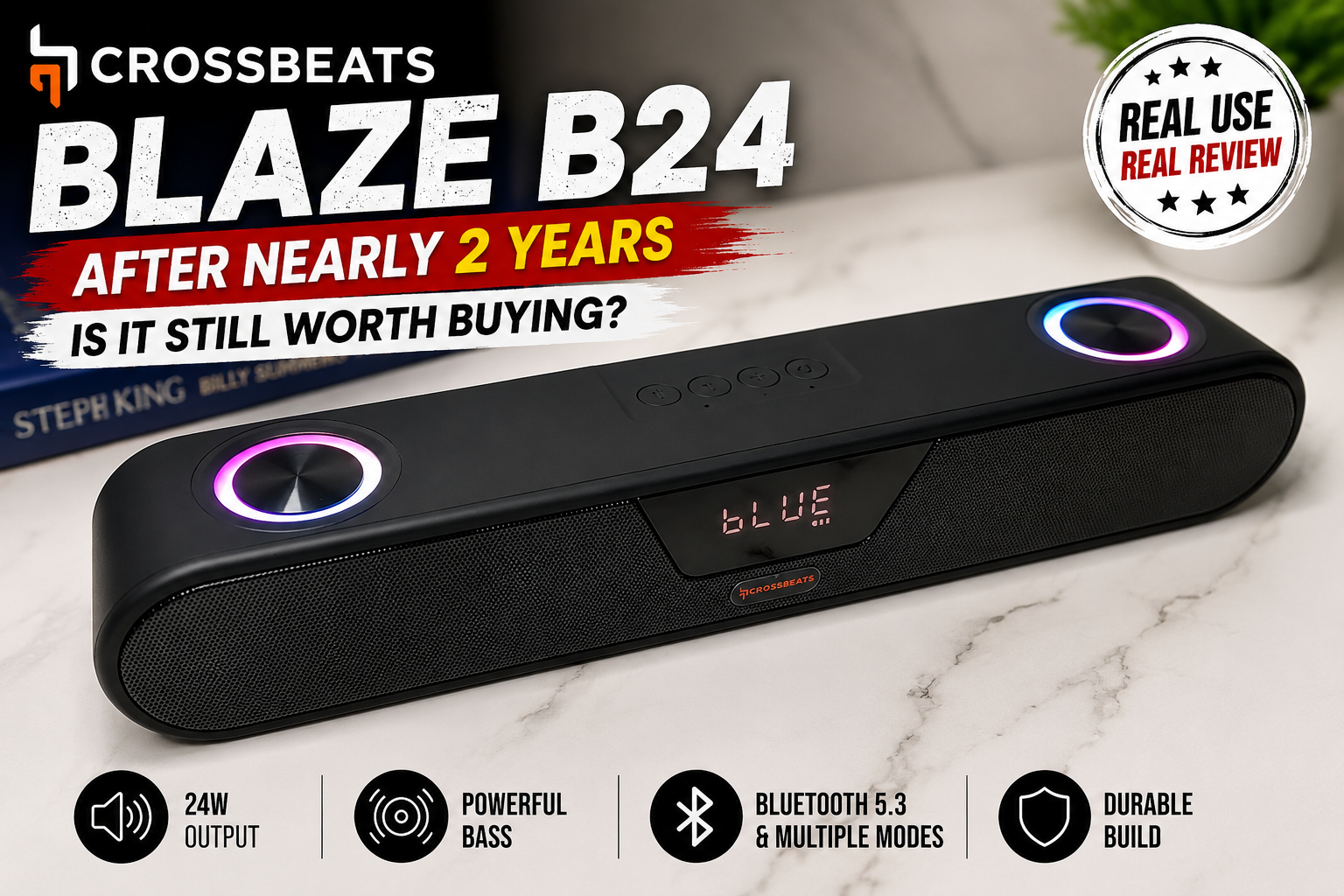
Crossbeats Blaze B24 Review After 2 Years: Is It Still Worth Buying?
Introduction
I bought the Crossbeats Blaze B24 back in August 2024 for ₹1,900. At the time, it felt slightly expensive to me, especially because there was no sale going on. Still, among the soundbars I had looked at in that price range, this was the one that seemed to justify its price the most.
My main reason for buying it was actually quite simple: I wanted a soundbar I could connect to my phone and use primarily for listening to music. I had also compared it with a few options from boAt and Mivi, but the Blaze B24 stood out to me with its combination of bass, loudness and compact design.
Almost two years later, I still use it regularly with my PC, laptop and phone. Most of the time, it is playing music, although I also use it for movies, gaming and, occasionally, watching the news.
And here’s the interesting part: my first impression of this soundbar hasn’t really changed. But using any product for nearly two years also reveals things you simply don’t notice in the first few weeks.
So, is the Crossbeats Blaze B24 still worth buying today? And does a soundbar that cost me ₹1,900 (about $20.00) in 2024 still make sense when you can find it for around ₹1,400 (about $14.70) today?
Here’s what my nearly two years of experience with it has actually been like.
My Experience With the Crossbeats Blaze B24
I bought the Crossbeats Blaze B24 in August 2024 for ₹1,900 (about $20 at the time). There wasn’t any sale going on when I bought it, so I did feel that it was slightly expensive. Still, I had compared it with soundbars from boAt and Mivi that were available in a similar price range, and the Blaze B24 was the one that seemed to justify its price the most.
My primary reason for buying it was music. I wanted something I could easily connect to my phone and use for listening to songs, rather than buying a soundbar specifically for movies or TV.
Over time, though, my usage expanded. I have used the Blaze B24 most often with my PC, laptop, and phone. Music remains my primary use, followed by movies, while I occasionally use it for watching the news and even gaming.
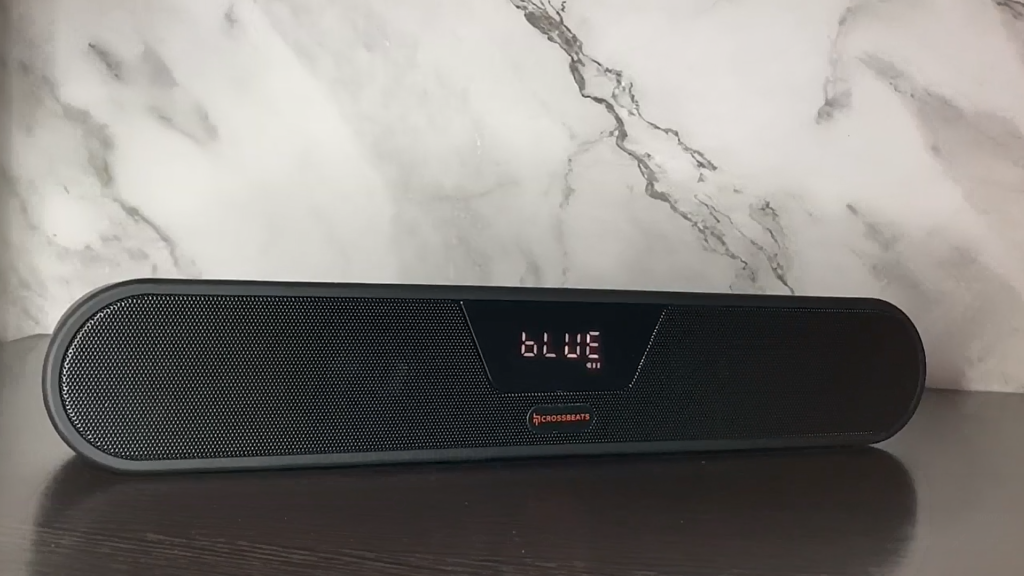
What I find interesting after nearly two years is that my initial impression hasn’t really changed. The bass, loudness, and design were the things that caught my attention when I first bought it, and even today, those remain some of the things I appreciate most about this soundbar.
That doesn’t mean everything has remained perfect, though. Long-term use has also revealed a few limitations that weren’t as obvious when I first started using it.
And that’s what makes this nearly two-year experience worth looking back at.
Sound Quality After Nearly Two Years
The first thing I noticed about the Crossbeats Blaze B24 was its bass, and almost two years later, it is still one of the things I like most about it. The bass sounds deep and punchy, whether I’m listening to music or watching a movie. Unless I start tweaking the equalizer, its overall character remains quite consistent across both.
The sound is slightly bass-heavy, but not to the point where everything else gets buried. Vocals remain clear, and instruments are still audible. However, I do feel that the soundbar gives the bass a little more priority than the rest of the frequency range.
The treble is where I think the Blaze B24 falls a little short. It is perfectly listenable, and I can hear the details, but I wouldn’t describe the highs as crystal clear. There’s a slight drop in refinement here, especially when compared with what you might expect from a more polished audio setup.
Volume is another strong point, particularly considering the soundbar’s compact size. It gets decently loud for a small or medium-sized room, and even in a larger room, it isn’t a bad performer. However, once I push the volume beyond roughly 80%, the sound starts to develop a noticeable harshness. It’s not something I encounter during normal listening, but it’s worth keeping in mind if you like listening at very high volumes.
For music, the combination of its thumpy bass and clear vocals is what I enjoy the most. In fact, I’m listening to music through the Blaze B24 while writing this article, which probably tells you more about my everyday experience with it than any specification sheet could.
Movies are also enjoyable on it, although long-term use has revealed one issue I didn’t notice earlier. Sometimes, when the background music gets loud, the dialogue can feel slightly faded or less prominent. It doesn’t happen in every scene, and it wasn’t something I experienced when I first bought the soundbar, but I have started noticing it occasionally now.
Overall, the Blaze B24’s sound signature is still quite enjoyable to me. It isn’t the most refined soundbar I’ve ever heard, but its deep bass, clear vocals, and decent loudness continue to make it a fun little speaker for everyday use.
If you enjoy reading about long-term audio experiences, you can also check out my AirPods Pro (1st Gen) After 4 Years Review, where I share how Apple’s first-generation AirPods Pro have held up after years of daily use.
Connectivity & Everyday Use
I have mostly used the Crossbeats Blaze B24 over Bluetooth, although I have also connected it occasionally through AUX and USB. Out of all these options, Bluetooth has easily been the most convenient for me, and it is the connection method I find myself using most often.
The Bluetooth experience has been quite reliable so far. Pairing is quick and easy, and in nearly two years of use, I haven’t experienced the connection randomly dropping on me.
The Blaze B24 comes with Bluetooth 5.3, and Crossbeats claims a range of up to 10 metres. In my experience, that claim has held up reasonably well. I can walk into another room while it’s connected to my device, and the connection generally stays intact without any noticeable problems.
I’ve used Bluetooth with my phone, laptop, and PC, and the experience has been broadly similar across all three. If I had to pick one, I’d give my laptop a slight edge for reasons I can’t quite explain—something about the overall experience just feels a little better there.
The 3.5mm AUX connection has been equally straightforward. I have used a 3.5mm-to-3.5mm cable with it, and the experience has been almost identical to Bluetooth in terms of everyday use.
One thing I particularly appreciate is that I haven’t noticed any meaningful audio delay while watching videos or movies. Lip-sync has remained accurate, which is exactly what I want from a soundbar used with a computer or laptop.
The physical controls are also decent. The buttons have a satisfying click to them and remain convenient to use even after nearly two years. Adjusting the volume or controlling playback is simple, without making me reach for the remote every time.
And then there’s the overall reliability. Apart from the occasional dialogue issue I mentioned earlier, I haven’t faced any noticeable hardware or connectivity problems. Bluetooth pairing remains solid, the buttons still work as they should, the speaker continues to get adequately loud, and I’ve never had a power-related issue.
For something I’ve been using regularly for almost two years, that level of reliability has been genuinely reassuring.
Modes, EQ & Extra Features
The Crossbeats Blaze B24 doesn’t come with dedicated Movie, Music, Gaming, or News sound modes, which is something you might find on some other soundbars. Instead, it offers a few different ways to play audio, including Bluetooth, SD card, and FM modes, along with AUX and USB connectivity.
I’ve personally tried all of these, but Bluetooth remains my favourite simply because it is the most convenient option for the way I use the soundbar. Most of the time, I just connect my phone, laptop, or PC and start listening.
The soundbar also gives me some room to adjust the sound manually. Since the bass is already quite rich and the vocals are clear, I usually tweak the settings slightly when I want the instruments to stand out more. I’m not looking for a completely different sound signature; I just want to bring out a little more detail in the instrumental parts.
There aren’t separate bass, treble, and mid controls built directly into the soundbar itself. However, when I connect it to my phone or laptop, I can make those adjustments from the source device, which has been sufficient for my needs.
I have also used the Blaze B24 for gaming on both my PC and laptop, and I haven’t encountered any noticeable problems. USB playback has been equally straightforward, with no major difference in experience compared with the other connection methods I’ve used.
Two features that I particularly appreciate at this price are its 24W RMS output with dual passive radiators and TWS support. The former helps the compact soundbar produce a surprisingly loud and punchy sound for its size. With TWS, you can pair another compatible soundbar to create a stereo setup, which I find to be a rather interesting addition for a product in this price segment.
For complete specifications and official product details, visit the Crossbeats Blaze B24 product page.
Overall, I wouldn’t call the Blaze B24 feature-packed in the conventional sense, but it does offer the features I have actually found useful over the years. For me, convenience matters more than having a long list of modes that I may never use.
Design, Build Quality & Long-Term Durability
One of the things that impressed me about the Crossbeats Blaze B24 when I first bought it was its design, and nearly two years later, I still feel the same way about it.
The soundbar has a compact bar-style design that looks quite pleasing on a desk. It doesn’t try to look overly flashy, but there is a certain premium aesthetic to it that I think works well for its price. More importantly, it still feels sturdy and well-built to me after all this time.
Crossbeats has used ABS + PC (Polycarbonate) for the body, and that gives the soundbar a solid feel when you pick it up. There’s also a metal grille at the front that protects the speaker components while adding to the overall look. For a compact soundbar, I think the combination works quite well.
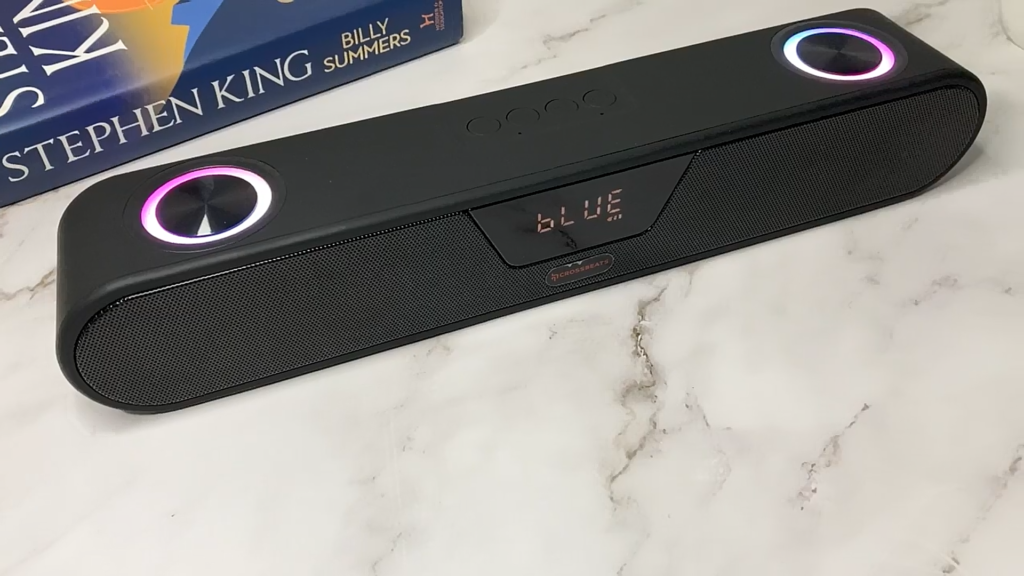
At roughly 15 inches in length and around 700 grams in weight, the Blaze B24 has also been very convenient for my setup. I primarily keep it on my desk, and it doesn’t take up an unreasonable amount of space. It’s compact enough to fit comfortably without making the desk feel crowded.
Of course, nearly two years of regular use hasn’t left it completely untouched. There are a few scratches on the body, which I consider fairly normal for a product that has been used for this long. However, I haven’t noticed any significant discoloration or loose parts.
The physical buttons have held up particularly well. They still have the same clicky feel they had when the soundbar was new, and I haven’t noticed any deterioration in their responsiveness.
I’ve also used the Blaze B24 for extended sessions. On several occasions, I’ve run it for more than six hours continuously, and I haven’t experienced any noticeable heating or performance issues.
After almost two years, the Blaze B24 still feels like a well-built and thoughtfully sized soundbar—and that’s something I didn’t necessarily expect when I first bought it.
Long-Term Performance: What Changed After Two Years?
After nearly two years of using the Crossbeats Blaze B24, the most interesting thing for me is how little its overall performance has changed.
The sound signature I liked when I bought it is still the reason I keep using it. The deep, punchy bass remains enjoyable, vocals are still clear, and the soundbar continues to deliver enough volume for my everyday use. I also haven’t noticed any meaningful drop in sound output over time.
What has changed is my understanding of its limitations. With longer use, I’ve become more aware of the harshness that appears beyond roughly 80% volume and the occasional situation where loud background music can make movie dialogues feel less prominent.
Apart from that, the Blaze B24 has aged surprisingly well for me. Bluetooth pairing remains reliable, the buttons still work as they should, and I haven’t experienced any power, heating, or major hardware issues despite using it for extended sessions.
So, two years later, I wouldn’t say the Blaze B24 has become a different product. I simply know it much better now—both its strengths and the compromises that come with them.
Price & Value for Money
When I bought the Crossbeats Blaze B24 in August 2024, I paid ₹1,900 (about $20). At the time, I did find the price slightly high, especially since there was no sale going on. But after comparing it with the other soundbars I was considering in the same budget, I felt that the Blaze B24 justified its price better than the alternatives I had looked at.
That was particularly because of the combination of sound output, punchy bass, compact design, and the features it offered. For what I paid back then, I felt I was getting a fairly complete package.
However, my view changes a little when I look at its price today.
If you can find the Blaze B24 for around ₹1,400 (about $14.70) or less, I would still recommend it. At that price, the 24W RMS output, dual passive radiators, TWS support, and the overall sound experience make it a reasonably compelling option based on my experience.
But I wouldn’t recommend buying it for ₹2,000 today. At that price, I think it starts feeling overpriced, especially when you’re buying a product that has been around for a while.
So, my 8/10 value-for-money rating is specifically based on the ₹1,900 I paid for it in 2024, not today’s pricing. At the right price, the Blaze B24 continues to offer enough for me to consider it a good buy—but price plays a much bigger role in that recommendation today than it did when I first bought it.
The Blaze B24 was a better value for me at ₹1,900 than it would be at ₹2,000 today—and surprisingly, I’d be even more comfortable recommending it around ₹1,400.
Is the Crossbeats Blaze B24 Still Worth Buying?
After using the Crossbeats Blaze B24 for nearly two years, I think it still makes sense—but only if you get it at the right price.
At around ₹1,400 (about $14.70) or less, I would still recommend it. You get the things that have worked well for me over the years: deep and punchy bass, clear vocals, decent loudness, reliable Bluetooth connectivity, and a compact design. The 24W RMS output, dual passive radiators, and TWS support also make it an interesting package at this price.
However, I wouldn’t recommend buying it at ₹2,000 (about $21.00) today. At that price, I’d personally start looking at alternatives, especially because the Blaze B24 has its limitations. The harshness at higher volumes and the occasional dialogue issue during movies are two compromises worth considering.
So, my recommendation is quite simple: if you find the Blaze B24 around ₹1,400 or below, it is still worth considering. At ₹2,000, I’d look elsewhere.
That is how I see this soundbar today after nearly two years of regular use.
My Final Verdict
After nearly two years with the Crossbeats Blaze B24, I can honestly say that it has been a surprisingly solid experience for me. I didn’t expect a ₹1,900 soundbar to remain this relevant in my daily routine for this long, but it has.
The things I liked about it from the beginning—its punchy bass, clear vocals, decent loudness, and compact design—are still the reasons I continue using it today. At the same time, long-term use has made me more aware of its limitations, particularly the harshness at higher volumes and the occasional dialogue issue when background music gets too loud.
My Ratings
Overall: 7/10
Value for Money: 8/10 (based on the ₹1,900 I paid in 2024)
The Crossbeats Blaze B24 isn’t a perfect soundbar, but it has delivered a dependable and enjoyable experience for almost two years. More importantly, it has continued to earn a place in my everyday setup, which is probably the best indication of how I feel about it.
If I had to sum up my entire experience in one sentence, I’d say this: the Crossbeats Blaze B24 has been a genuinely solid experience that I didn’t expect when I first bought it.
Conclusion
After nearly two years with the Crossbeats Blaze B24, I wouldn’t call it a perfect soundbar, but I can confidently say that it has earned its place in my setup.
Its punchy bass, clear vocals, reliable connectivity, and compact design have kept me coming back to it, especially for music. At the same time, the limitations I’ve noticed over time—particularly the harshness at higher volumes and occasional dialogue issues during movies—are worth keeping in mind.
Would I buy it again for ₹1,900 today? No. But at around ₹1,400 or less, I still think it offers enough to be worth considering.
For me, this has been a genuinely solid experience—one that turned out to be better than I expected when I first bought it in August 2024.
Sometimes, a product doesn’t need to be perfect to become a product you genuinely enjoy using.